
Analog Computing: Are the Billions Invested in GPUs Going to Waste?
A 2,000-year-old technology could save us from the impending AI Bubble pop.
For the past few weeks you have probably come across press headlines about the AI bubble, or Michael Burry, famous for predicting the 2008 subprimes crisis, betting on AI’s downfall, along with many other articles questioning the development and sustainability of AI. Even Sundar Pichai, Google’s CEO, warned in November of some “irrationality” in the current AI boom and that “every company would be affected if the AI bubble were to burst” in an article for the BBC.
Investors and financial authorities are raising legitimate questions about whether record investments will materialize into returns. An interesting visualization helps us see the investment flows as a diagram and provides a bird’s eye view of what leading bank analysts sometimes call “circular investing”.
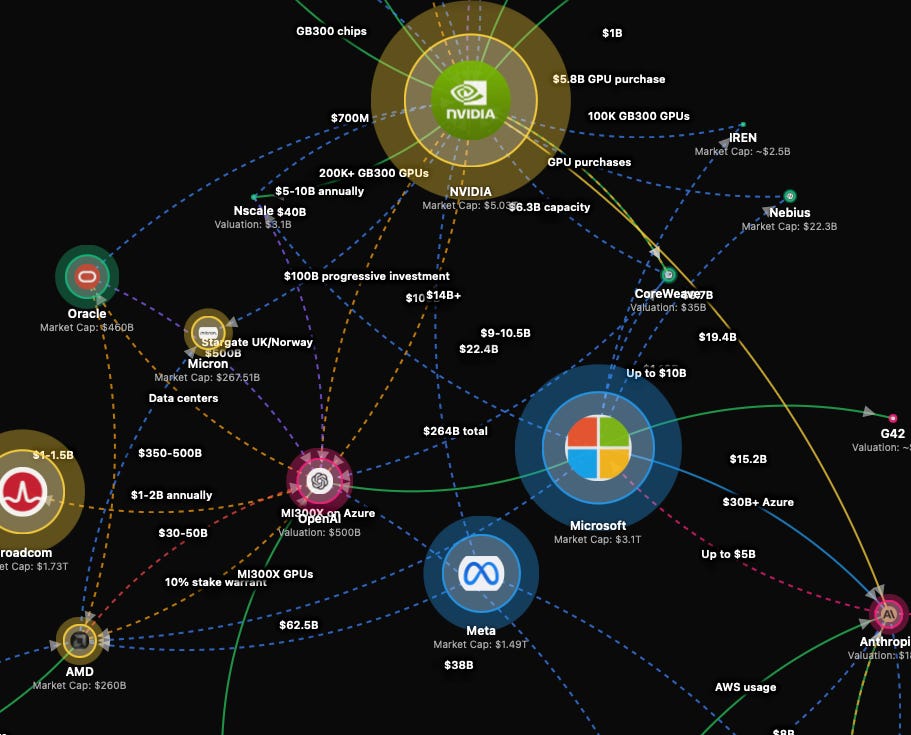
Screenshot of https://aibubble.online/network-visualization, consulted on 20/11/25
Beyond speculation, AI faces physical limits.
First, physical limits: as transistors shrink, more of them fit in the same space, boosting computer efficiency. We keep increasing the number of transistors, but this can’t last. Indeed, “The fact that materials are made of atoms is the fundamental limitation and it’s not that far away” (Gordon Moore, Intel co-founder), although we haven’t reached this limit yet, we cannot decrease the size of components indefinitely.
Moreover, AI’s voracious appetite for energy is rapidly raising concerns. Data centers are increasingly unwelcome in many communities, described as “energy ogres” by local residents who question whether they represent progress or danger. If you want to dig deeper into the subject of energy demand from AI, you can look at this page from the International Energy Agency, with figures and previsions.
As Microsoft Research puts it: “Exponential advances in digital hardware have both driven and benefited from the rise of artificial intelligence, but its escalating energy and latency demands push digital specialization to its limits”.
The answer to AI’s limits may lie in a centuries-old technology: analog computing
The earliest evidence of analog computers dates back to ancient Greece with the Antikythera mechanism. It was developed, and then modern digital computing eventually took over, as it was “easier to program and often more accurate than analog machines“
To put it simply:
Digital systems rely on binary 0/1 states, with efficiency tied to the number of transistors. It works following a program stored in its memory.
Analog systems operate through continuous physical signals (for example voltage or electric current), they have an infinite number of states, enabling extremely dense and energy-efficient computations. It doesn’t have program memory and it isn’t controlled by stored instructions.
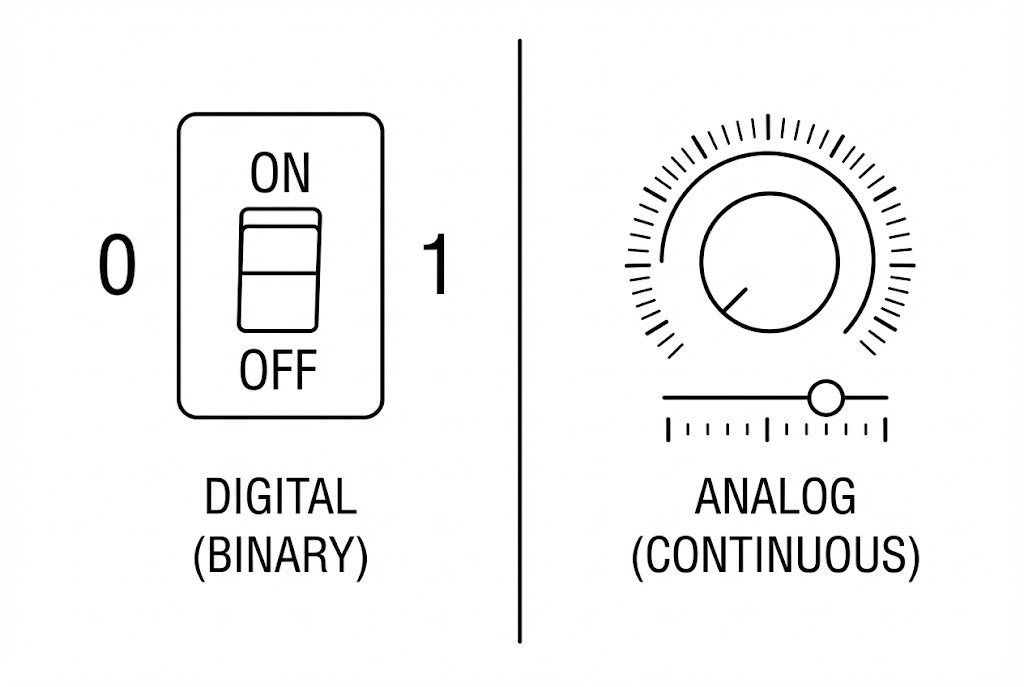
Digital computing uses discrete binary values, while analog computing works with continuous signals.
And here’s the thing: every time a computer switches a bit from 0 to 1 or 1 to 0, it uses energy, and modern AI systems need a massive amount of computing power. And because digital computing is becoming so energy-hungry, researchers are looking again at analog computing as a possible alternative.
Why is analog computing experiencing renewed interest today?
Analog computing has been quietly making a comeback for the past few years, actors like IBM, the MIT, and companies like Mythic or Aspinity have been researching and developing analog technology applications in the AI sector. The company Mythic explained in an article for Forbes that they are looking “to solve the technical and physical bottlenecks that limit current processors through the use of analog compute in a world dominated by digital technology”.
This September, Microsoft research team published a paper about “Analog optical computer for AI inference and combinatorial optimization”. An analog optical computer (AOC) uses light and analog electronics. Without going into the details of the technology, what is important to note is that the authors estimate that with realistic scaling, an AOC system could be 100x more energy-efficient than Nvidia H100 GPUs.
In October, researchers from Peking University published a paper introducing a new analogue chip designed to handle demanding calculations used notably in AI. By combining fast, low-precision analog steps with highly accurate ones, their prototype matches the precision of modern digital processors while using much less power. The researchers estimate that, with further development, this approach could be up to 1,000× faster and far more energy-efficient than today’s top GPUs like Nvidia’s H100.
Yet applying analog computing to AI has key constraints
Analog computing is facing some challenges, mostly due to its reliance on continuous signals, which results in lower precision and higher susceptibility to noise and degradation compared to digital systems (the binary 0s and 1s have no ambiguity). Furthermore, analog hardware is generally specialized, designed to solve specific problems (like a calculator that can only perform four basic operations), making it unsuitable for general-purpose computing (like your laptop which has a calculator app, but also runs browsers, edits documents, and plays games interchangeably). In addition, analog systems face other challenges, still lacking the robust programmability, scalable architectures, and mature design toolchains needed for widespread adoption.
A hybrid future?
But analog computing is not here to replace digital computing. Digital computing has real benefits, offering yet unmatched reliability, flexibility and maturity. In most articles we came across, the solution seems to be in a hybrid future of computing. Combining the precision of digital with the efficiency of analog systems.
Ahybrid future that would bring the best of both digital and analog computing. Could yesterday’s technology save tomorrow’s AI? While the AI bubble may burst if returns don’t materialize, analog computing could be a crucial technology that, by combining its strengths to digital computing, gives AI a more sustainable future. It might be too soon to say, but there are signals pointing in this direction.
Thank you for reading! Is analog computing the breakthrough AI needs, or just another tech trend? We’d love to hear your perspective, share your thoughts in the comments below.
This week’s curated news:
AI Agents Autonomously Exploit $550M in Smart Contract Vulnerabilities
An Anthropic research shows that models like Claude 4.5 and GPT 5 can independently identify and exploit blockchain flaws, including zero-day vulnerabilities in recently deployed contracts, underscoring rising cybersecurity risks.
Read the full news here.
ChatGPT Ads on Hold: OpenAI Declares Code Red to Fix Core Experience
Following leaks about ad tests, OpenAI has halted multiple initiatives to prioritize speed, reliability, and personalization amid tightening competition from Google and Anthropic.
Read the full news here.
The Era of Generative Shopping Begins: AI Agents are Ready to Click “Buy”
Just ahead of Black Friday, both companies unveiled AI agents that can guide, compare, and even autonomously purchase products, ushering in the era of generative shopping and a future where brands optimize for algorithms, not humans.
Read the full news here.
Jeff Bezos Launches $6.2B Project Prometheus on Physical AI
Bezos returns to an operational role to co-lead a massively funded AI startup focused on real-world “world models,” signaling a major shift from digital to physical AI and attracting top researchers from OpenAI, DeepMind, and Meta.
Read the full news here.
🔍 Dive Deeper into Digital Disruption
Explore the 2025 Digital Disruption Matrix → Your guide to navigating digital transformation with confidence. This annual barometer combines rigorous data analysis with human perspective to rank this year’s most disruptive technologies. Discover how blockchain, AI, Web3, and emerging innovations are reshaping industries.
💡 Never Miss an Insight
To get weekly analysis on emerging technologies and digital transformation delivered to your inbox, follow us on Substack.
Follow the Digital Disruption Chair on LinkedIn for regular insights, interviews, comments and articles on frontier technologies.
Learn more about our programs | Contact us
Bibliography:
Aliaga, S. (2025, October 17). Does circularity in AI deals warn of a bubble? JP Morgan. https://am.jpmorgan.com/us/en/asset-management/adv/insights/market-insights/market-updates/on-the-minds-of-investors/does-circularity-in-ai-deals-warn-of-a-bubble/
Angrand, M. (2025, October 17). « Bulle de l’IA » et record de l’or, deux interrogations qui animent les marchés financiers. https://www.lemonde.fr/economie/article/2025/10/17/bulle-de-l-ia-et-record-de-l-or-deux-interrogations-qui-animent-les-marches-financiers_6647721_3234.html
Bela, V. (2025, October 21). China’s analogue AI chip could work 1,000 times faster than Nvidia GPU: Study. South China Morning Post. https://www.scmp.com/news/china/science/article/3329820/chinas-analogue-ai-chip-could-work-1000-times-faster-nvidia-gpu-study
Belostotski, L., Uddin, A., Madanayake, A., & Mandal, S. (2025). A Survey of Analog Computing for Domain-Specific Accelerators. Electronics, 14(16), 3159. https://doi.org/10.3390/electronics14163159
Energy demand from AI – Energy and AI – Analysis. (n.d.). IEA. Retrieved November 25, 2025, from https://www.iea.org/reports/energy-and-ai/energy-demand-from-ai
Freund, K. (2022, July 30). Mythic: How An Analog Processor Could Revolutionize Edge AI. Forbes. https://www.forbes.com/sites/karlfreund/2022/07/30/mythic-how-an-analog-processor-could-revolutionize-edge-ai/
Harvie, L. (2025, July 24). The Promise of Analog AI: Could In-Memory Computing Revolutionize Edge Devices? - RunTime Recruitment. Runtime Recruitment. https://runtimerec.com/the-promise-of-analog-ai-could-in-memory-computing-revolutionize-edge-devices/
Islam, F., & Clun, R. (2025, November 18). Google boss says trillion-dollar AI investment boom has “elements of irrationality.” BBC. https://www.bbc.com/news/articles/cwy7vrd8k4eo
Kalinin, K. P., Gladrow, J., Chu, J., Clegg, J. H., Cletheroe, D., Kelly, D. J., Rahmani, B., Brennan, G., Canakci, B., Falck, F., Hansen, M., Kleewein, J., Kremer, H., O’Shea, G., Pickup, L., Rajmohan, S., Rowstron, A., Ruehle, V., Braine, L., … Ballani, H. (2025). Analog optical computer for AI inference and combinatorial optimization. https://www.microsoft.com/en-us/research/publication/analog-optical-computer-for-ai-inference-and-combinatorial-optimization/
Karnbach, J. (2025, July 23). Analog Chip May Be Key to Unlocking AI Power | Ole Miss. https://olemiss.edu/news/2025/07/analog-chip-may-be-key-to-unlocking-ai-power/index.html
La multiplication des “data centers” autour de Marseille, progrès ou danger ? - ICI. (2025, November 6). ICI, le média de la vie locale. https://www.francebleu.fr/infos/societe/la-multiplication-des-data-centers-autour-de-marseille-progres-ou-danger-2431631
Michael Burry, « l’oracle » des subprimes, parie sur la chute de l’IA. (2025, November 8). Les Echos. https://www.lesechos.fr/tech-medias/intelligence-artificielle/michael-burry-loracle-des-subprimes-parie-sur-la-chute-de-lia-2197614
Moyer, M. G. L. +1 authors M. (2024, August 2). What Is Analog Computing? Quanta Magazine. https://www.quantamagazine.org/what-is-analog-computing-20240802/
New algorithms may enable training AI models on analog chips. (2021, February 9). IBM Research. https://research.ibm.com/blog/analog-in-memory-training-algorithms
Terpil, J. (n.d.). The AI Bubble—Track Who’s Funding Who. Retrieved November 25, 2025, from https://aibubble.online/
Zewe, A. (2022, July 28). New hardware offers faster computation for artificial intelligence, with much less energy. MIT News | Massachusetts Institute of Technology. https://news.mit.edu/2022/analog-deep-learning-ai-computing-0728
Zuo, P., Wang, Q., Luo, Y., Xie, R., Wang, S., Cheng, Z., Bao, L., Wang, Z., Cai, Y., Huang, R., & Sun, Z. (2025). Precise and scalable analogue matrix equation solving using resistive random-access memory chips. Nature Electronics, 1–12. https://doi.org/10.1038/s41928-025-01477-0